Professor David McMurray from The International University Kagoshima was interviewed about English haiku by Ms Kamoshima at the Kitanippon Shimbun based in Toyama Prefecture in Japan. In the interview, he talked about the relationship between haiku and global warming, and the future of haiku.
First of all, here is a copy of part of the newspaper article.
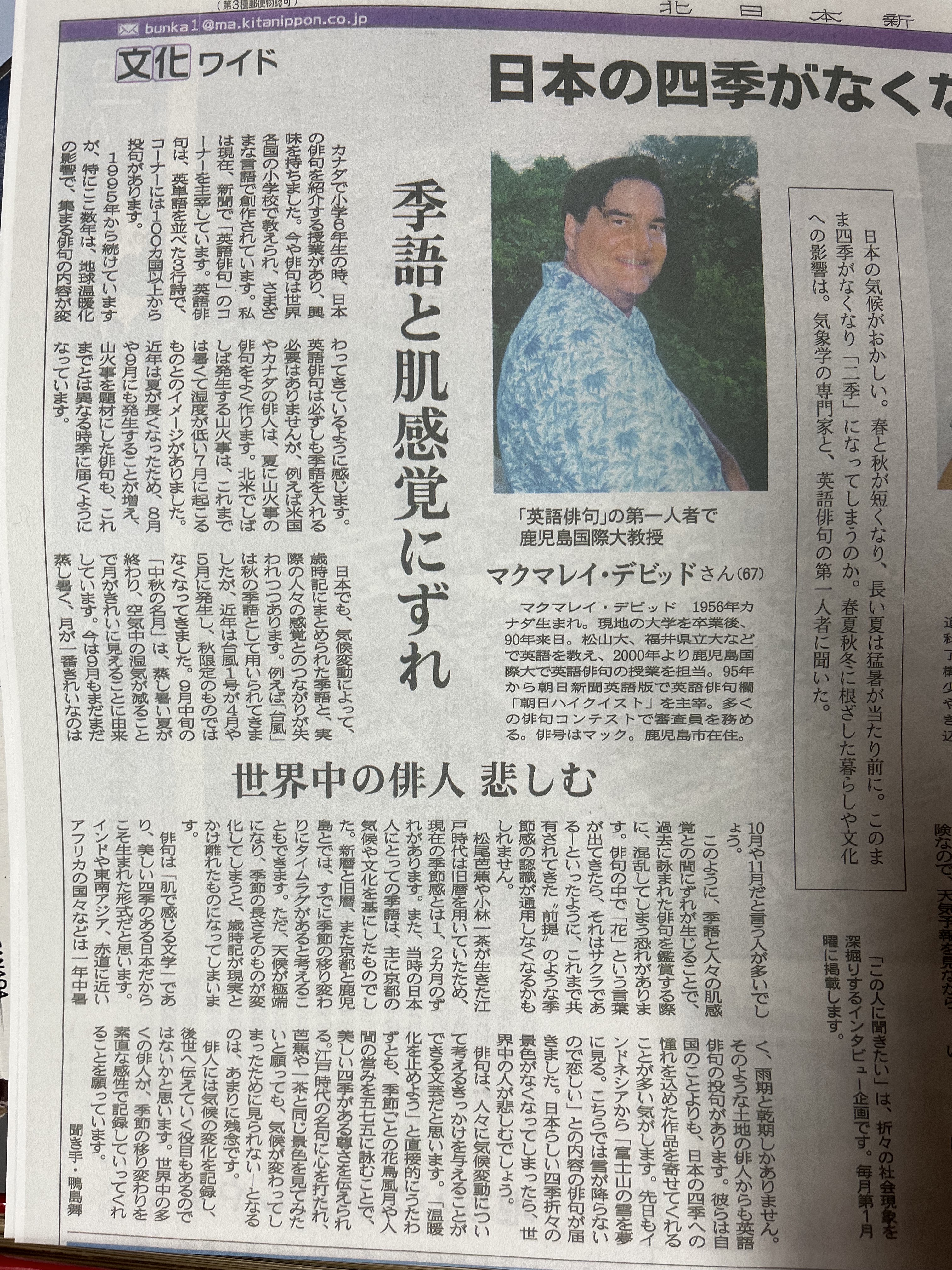
Secondly, the article is introduced in Japanese as follows.
鹿児島国際大学のマクマレイ・デビッド教授は北日本紙から英語俳句についてインタビューを受けました。インタビューの内容では俳句と地球温暖化の関係、また今後の俳句のあり方について話されていました。以下の文は本記事の内容を一部抜粋し要約した内容です。
北日本紙がマクマレイ教授にインタビュー
カナダで小学6年生の時、日本の俳句を紹介する授業で興味を持ちました。今では俳句は世界各国の小学校で教えられ、様々な言語で創作されています。私は現在、新聞で「英語俳句」のコーナーを主宰し、100カ国以上の国から英単語を並べた3行詩が投稿されています。1995年から続けられているこのコーナーでは、最近ある影響により俳句の内容が変化している気がします。それは「地球温暖化」の影響です。英語俳句は必ずしも「季語」を入れる必要はありませんが、例えば米国やカナダの俳人は夏に山火事についての俳句をよく作ります。北米でしばしば発生する山火事は、暑くて湿度の低い7月に起こるイメージでした。しかし、近年は夏が長くなり、8月や9月にも発生することが増え、山火事を題材にする俳句もこれまでとは異なる季節に届くようになっています。
同じく日本でも、気候変動により歳時記にまとめられた季語と実際の人々の感覚との繋がりが失われつつあります。例えば以前までは台風は秋の季語として用いられていましたが、近年では台風1号が4月など早い段階に発生し、秋限定の出来事ではなくなってきています。このように季語と人々の肌感覚との間にズレが生じることで、過去に詠まれていた俳句を現在詠むと混乱してしまう恐れがあります。地球温暖化の影響により季節感の認識が通用しなくなるかもしれません。松尾芭蕉や小林一茶が生きた江戸時代は旧暦を用いていたため、現在の季節感とは1、2ヶ月のずれがあります。また、当時の日本人にとっての季語は、主に京都の気候や文化を基にしたものでした。新暦と旧暦、京都と鹿児島とでは季節の移り変わりにギャップがあると考えられます。ただ、気候が極端になり季節の長さそのものが変化してしまうと、歳時記が現実とかけ離れたものになってしまいます。俳句は「肌で感じる文学」であり、美しい四季のある日本だからこそ生まれた文化だと思います。
季節のあまり変化のない赤道付近のアフリカの国々やインド、東南アジアで詠まれる俳句には、自国についてではなく日本の四季への憧れを込めた作品が多数寄せられます。先日もインドネシアから「富士山の雪を夢に見る。こちらでは雪が降らないので恋しい」との内容の俳句が届きました。地球温暖化により日本らしい四季折々の季節がなくなってしまうと、世界中の人が悲しむでしょう。俳句は人々に気候変動について考えるきっかけを与えることができる文芸だと思います。これから、芭蕉や一茶と同じ景色を見たいと願っても、気候が変わったために見られないとなるとあまりに残念です。俳人には気候の変化を記録し、後世へ伝えていく役目もあるのではないかと思います。日本だけでなく、たくさんの国で季節の移り変わりを素直な感性で記録してくれることを願います。
Lastly, the following text is a translation of a summary of the contents of the original half-page article and photograph that was printed on September 2, 2024.
Kitanippon Shimbun Interviews Professor McMurray
When I was in the sixth grade of elementary school in Canada, I became interested in Japanese haiku when my teacher introduced a few 5-7-5 syllable poems during a class of English poetry. That was a long time ago, but I understand that today haiku is taught in schools in the U.K., U.S., and other countries around the world and is written in various languages.
I currently run a column in the Asahi Shimbun newspaper entitled “Asahi Haikuist Network,” where one and three-line poems are submitted by haikuists from over 100 countries and published here https://www.asahi.com/sp/ajw/special/haiku/
This weekly, or sometimes biweekly, column has been running since 1995, but I feel that the content of the haiku has recently been changing due to the climate crisis. Haiku is influenced by “global warming.” English haiku do not necessarily need to include a “seasonal word,” but they often do. For example, haiku poets in the United States and Canada are currently sending me haiku about forest wildfires in the summer. Forest fires, which often occur in North America, usually occur in July, a month when the weather is hot and dry. However, in recent years, summers have become longer, and wildfires are occurring more frequently in June, July, August and September. Haiku related to forest fires are arriving at my university research lab over a span of several months—a much longer summer season than 30 years ago when I started curating the newspaper column.
Similarly, in Japan, climate change is changing our haiku. Global warming is causing the relationship between the seasonal words compiled in traditional saijiki and the actual sensibilities of people to be lost. For example, typhoons used to be a seasonal word for autumn, when they used to begin. But in recent years, typhoons have started to occur earlier, as early as in April, and are no longer limited to autumn. That is because the temperature of the oceans surrounding Japan are being super heated. Typhoons are natural cooling phenomena.
Because of this discrepancy between seasonal words and people’s visceral sensations, there is a risk of confusion when haiku that were written in the past are written today. The effects of global warming may make our perception of seasonality no longer valid. The Edo period, when Matsuo Basho and Kobayashi Issa lived, used the lunar calendar, which is one or two months out of sync with the current sense of seasons. In addition, the seasonal words for Japanese people at that time were mainly based on the climate and culture of Kyoto. There is likely to be a gap in the change of seasons between the new and lunar calendars, and between Kyoto and where poets live. Certainly Akita Prefecture and Kagoshima Prefecture have different climates than the former capital. Additionally, if the climate becomes extreme and the length of the seasons themselves changes, the saijiki will become far removed from reality.
Haiku is “literature that you feel with your skin,” and I believe it is a culture that was born precisely because Japan has beautiful four seasons. I receive many haiku poems written in African countries. As well I enjoy reading poems penned near the equator, such as India, and Southeast Asia, where the seasons change from dry to wet. Noticeably, many of these haiku are filled with admiration for Japan’s four seasons rather than about their own country. Just the other day, I received a haiku from Indonesia that read, “I dream of snow on Mt. Fuji. I miss it because it doesn’t snow here.” If global warming causes Japan’s unique four seasons to disappear, foreign people including tourists and haikuists all over the world will be sad.
I think haiku is a literary form that can give people an opportunity to think about climate change. It would be such a shame if haiku aficionados wished to experience the same scenery that inspired beautiful poems by Basho and Issa, but could no longer do so because the climate has changed. I think haiku poets have a role to play in recording climate change and passing it on to future generations. I hope that haiku poets will record the changing seasons with honest sensibility not only in Japan, but in many other countries as well.
///
Hidenori Hiruta
Akita International Haiku Network

 Akita International Haiku Network
Great article, Hidenori San. Thank you for sharing.
Climate change is having an enormous impact in Mauritius too. Whereas we have only two seasons here since time immemorial, now it’s normally warm because we are in summer, it is so cold as if we are living winter in Uk.
Summer at its peak
Woolen socks and leather boots
Cold sun is shining
Warm regards
Anita Bacha
it is a very amazing article. I like haiku and I initiated to learn haiku when I was a university student.
I’m glad to hear that Kitanippon Shimbun Interviews Professor David McMurray. I’m also concerning about global warming. He mentioned that Haiku related to forest fires are arriving at IUK over a span of several months which means summer season has been becoming longer than 30 years ago. I think that it is interesting that each country has different Kigo. (For instance , Japanese people may not think that forest fire is summer kigo of Japan.) I like Japanese four seasons especially snow season because Kagoshima has fewer snow season. I guess it used to snowed more in Kagoshima some decades ago. I agree that the haiku reflect the climate conditions of the time.
I think Professor McMurray’s point of view is very original and interesting , seasonal words have always been a very important part of haiku. Not only has global warming had an impact on haiku, but technological advances and changes in the humanities have also had a huge impact on haiku. haiku themes have also changed with the times, and Masaoka Shiki has written about many new haiku themes, such as baseball and trains. The mold-ability of haiku is what I love about it.
After reading Mr. McMurray’s materials, I am deeply sorry that the destruction of nature cannot be valued by people, like good poetry cannot be understood. Mr. McMurray said that haiku is a communication between nature and the body, but too few people can slow down to communicate with nature. Haiku is romantic, and he records the moment of the current climax. He is a video recorder of words, telling and warning later generations how beautiful our world was before this. Thank you very much to Mr. McMurray for letting more people understand haiku. Behind such beautiful words are questions worth thinking about. Thanks