The Appearance in Hokusai’s Sketches

This is a piece of the sketches in The Hokusai Manga, or Hokusai’s Sketches, a collection of sketches of various subjects drawn by the Japanese artist Katsushika Hokusai (Published 1814-1878).
Hokusai sketched En no Ozunu and two demonic spirits, or demons in his Manga.
En no Ozunu, or En no Gyōja was born in 634 and first lived in Mount Katsuragi in Nara Prefecture and was acclaimed for his sorcery.
Rumor says, “Ozunu was able to manipulate demonic spirits, or demons for his sorcery, making them draw water and gather firewood. When they disobeyed, he bound them using sorcery.”
Note: The Hokusai Manga「北斎漫画, or Hokusai’s Sketches」
This is a collection of sketches of various subjects drawn by the Japanese artist Katsushika Hokusai 「葛飾北斎」(Published 1814-1878).
Note: Two Demonic Spirits, or demons in the sketch
Two demonic spirits, or two demons, were imagined to be “mountain people” who lived in the mountains, where the power of the Ritsuryō state did not cover. This is reflected in the appearance of Zenki (前鬼), or the demon (鬼)and Goki (後鬼), or the demon (鬼) They were said to be a married couple, who obeyed and took care of En no Ozunu.
Her husband, Zenki, was a red demon holding an iron ax in his hand, and as his name suggests, he advanced in front of Ozunu and cleared the path. He often carried a knapsack on his back. He was said to be from present-day Shimokitayama Village, Yoshino District, Nara Prefecture.
His wife, Goki, was a blue demon holding a water jar filled with risui (water with spiritual power) and carried a knapsack containing seeds on her back. She was said to be from present-day Tenkawa Village, Yoshino District, Nara Prefecture.
Note: 「三吉」 Mi-yoshi or San-kichi
En no Gyōja, or En no Ozunu was nicknamed Mi-yoshi or San-ki-chi in Akita Prefecture.
Mi-yoshi ← Mi (三) + yoshi (吉) ← yoshi-no (吉野)
San-ki-chi ← San (山) + ki (鬼) + chi (霊)
The Appearance in Bonden Festival
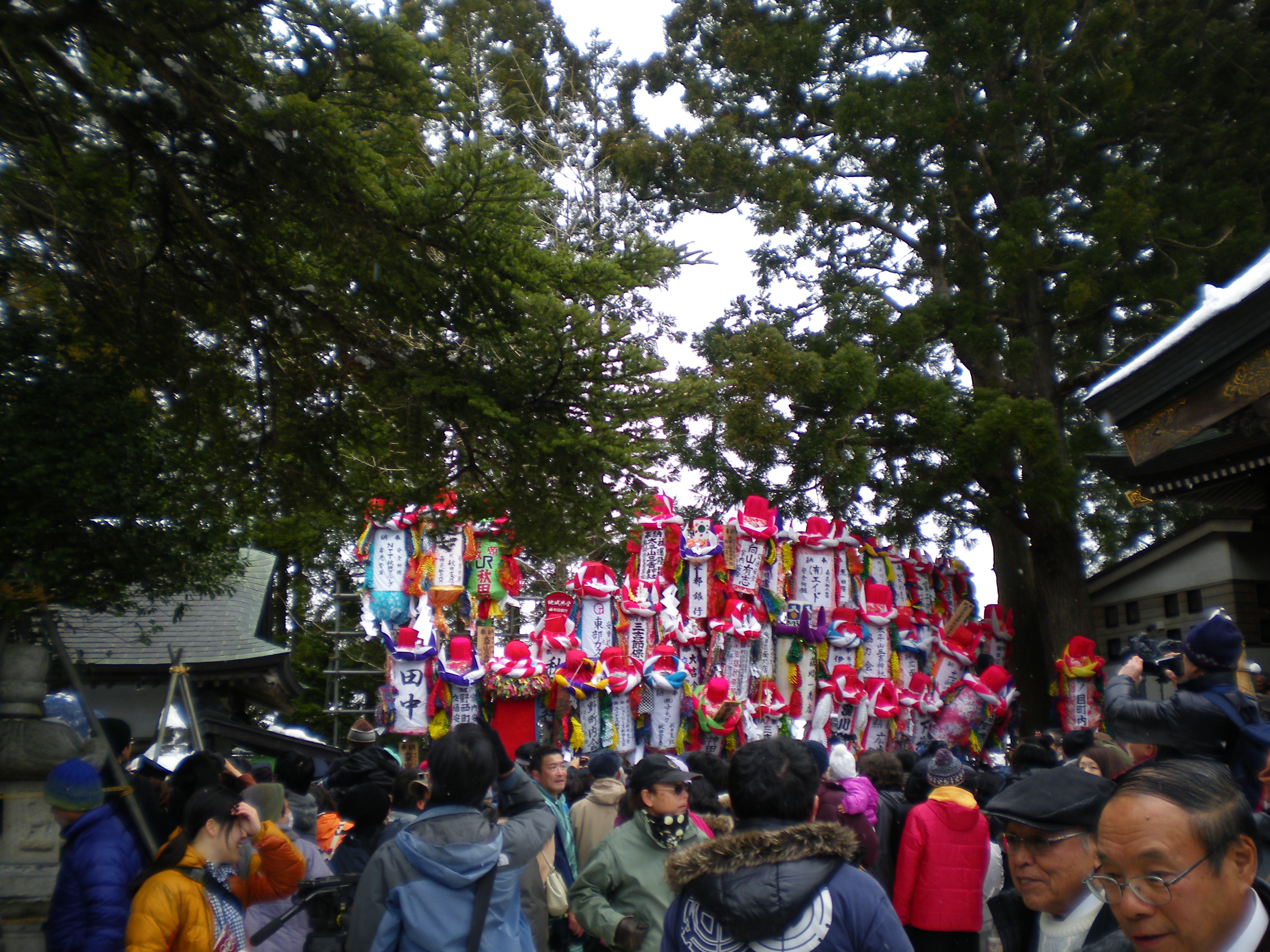
The Bonden Festival is held at the shrines in January and in February in Akita City. The festival takes place as if it were dedicated to En no Gyōja because he is deified as one of the enshrined deities of each shrine. The name of deity is Miyoshino-ō-kami, or the Great God Miyoshi.
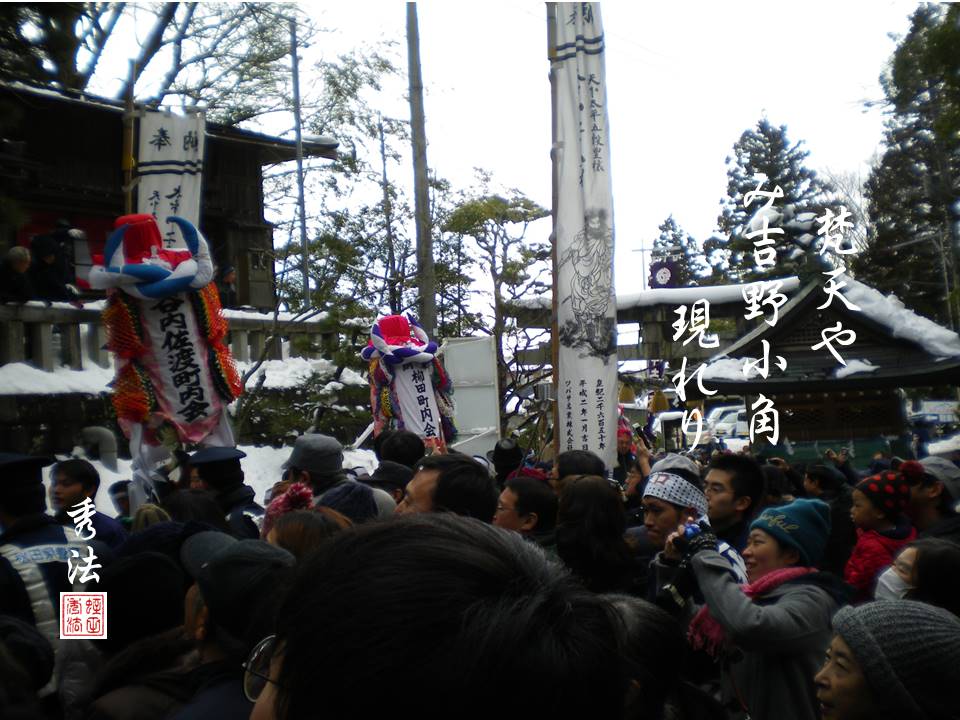
Bonden festival
attracting the divine spirits of
Miyoshino Ozunu
It seems that “En no Ozunu, or Miyoshi” appears here at the Bonden festival.
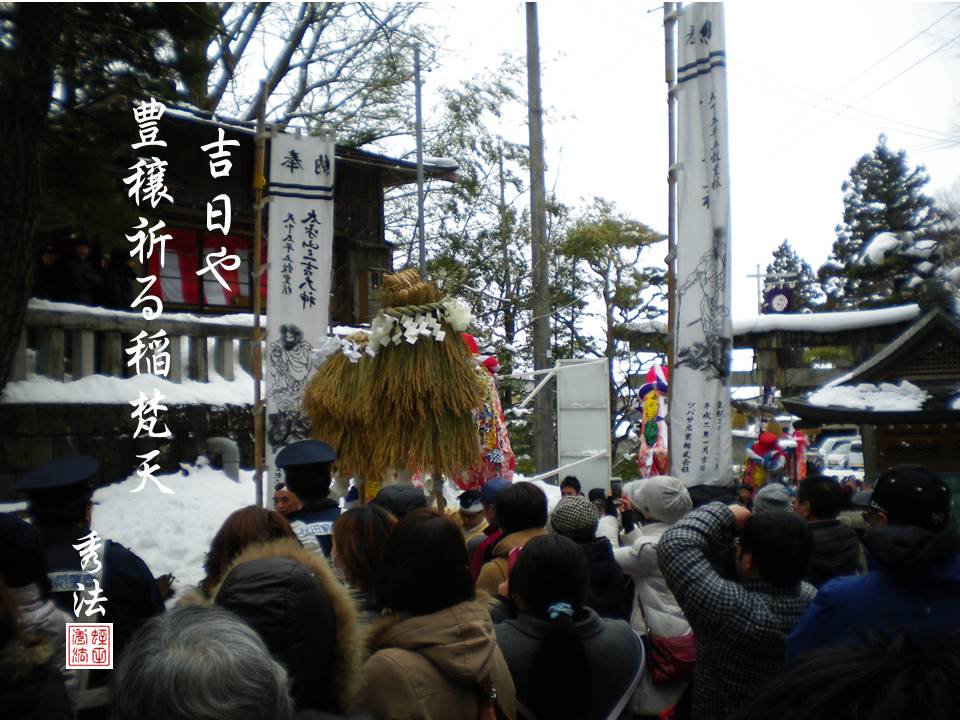
The rice Bonden
wishing for good harvest
on the auspicious day
On January 17 (by the lunar calendar), 1863, a mysterious figure appeared holding a rice Bonden in his right hand and a sake cup in his left hand in Miyoshi-jinja Shrine at Kisoishi, Taihei, Akita City. Bonden festival is said to have been held every year since then.
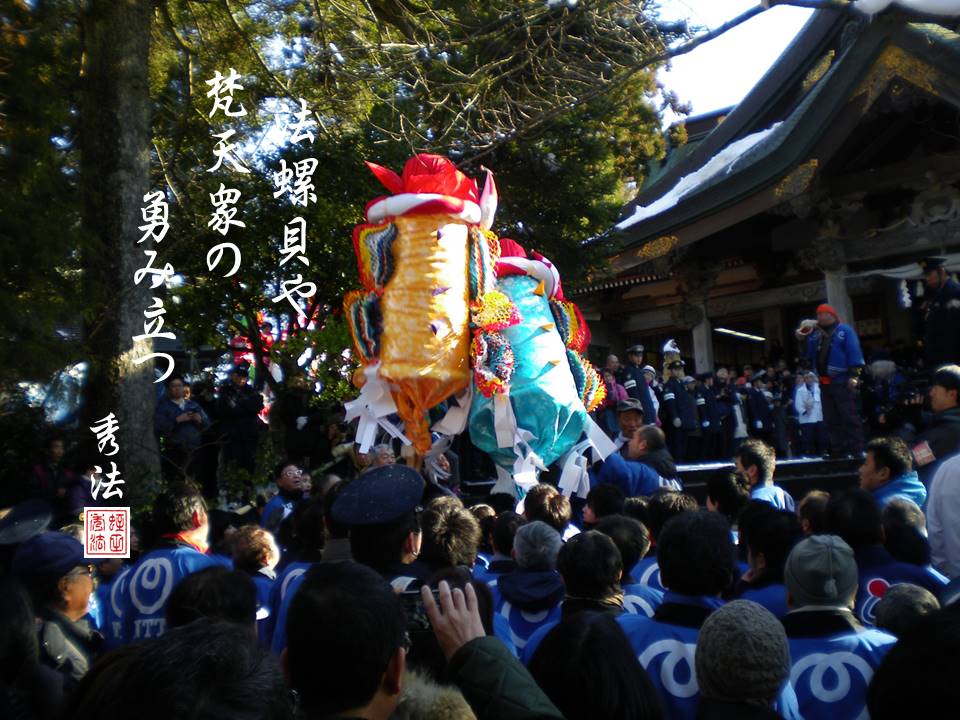
The conch horn
exciting the Bonden men
into higher spirits
The hora, or conch horn「法螺」is especially associated with yamabushi 「山伏」, ascetic warrior monks of the Shugendō tradition. Yamabushi used the trumpet to signal their presence to one another across mountains and also to accompany the chanting of sutras. The hora, or conch horn「法螺」is used in the Bonden festival, too.
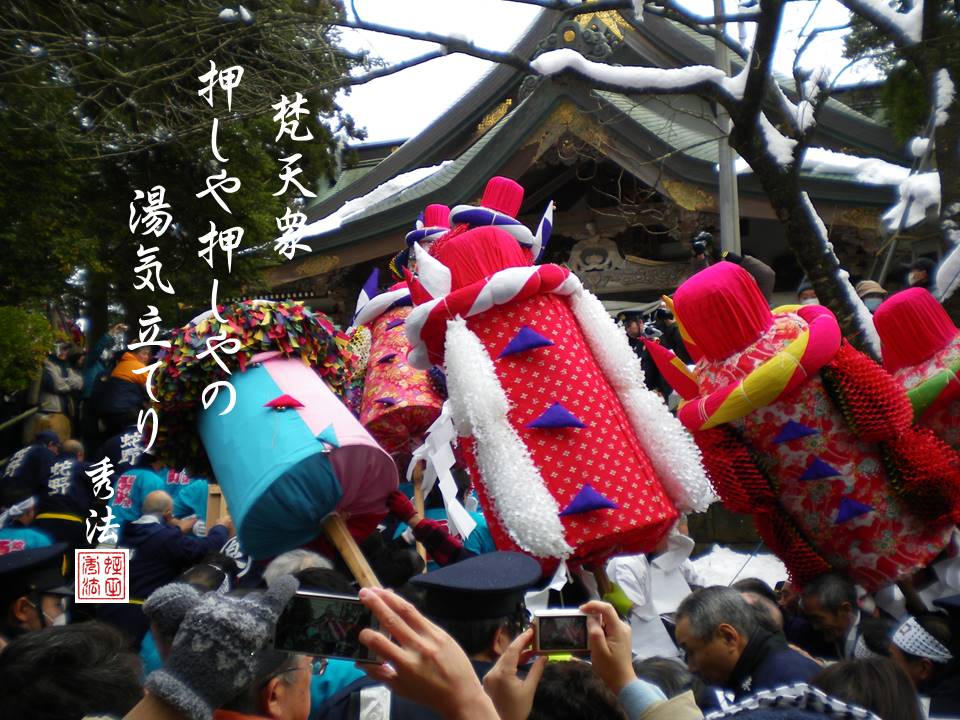
The Bonden men
pushing and jostling
sending out steam
In 673, En no Ozunu founded a temple on the top of Mount Taihei to gain supernatural power through discipline. Later he became a divine being of power as one of the deities of the shrine. At the Bonden festival, each team dedicates their Bonden to the shrine energetically, showing how hard they have trained or how powerful they are among all Bondenmen.
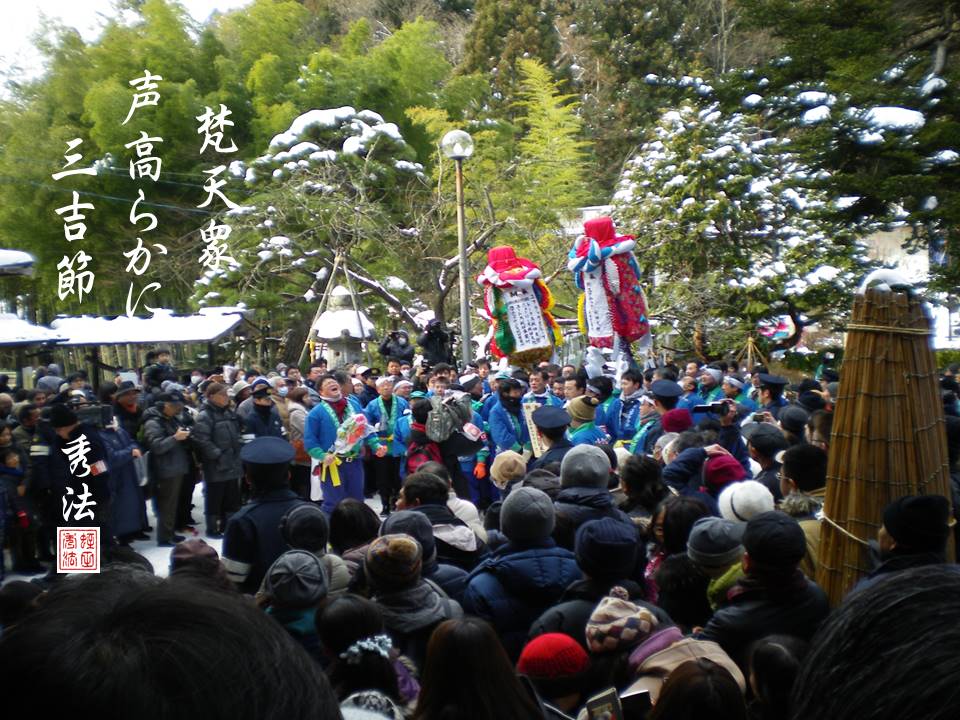
The Bonden man
singing in a loud voice
Bonden festival song
A large audience and the other Bondenmen listened earnestly to Miyoshi Bonden festival song on the morning of January 17 (by the Gregorian calendar) at Taiheizan Miyoshi-jinja Shrine at Akanuma, Akita City.
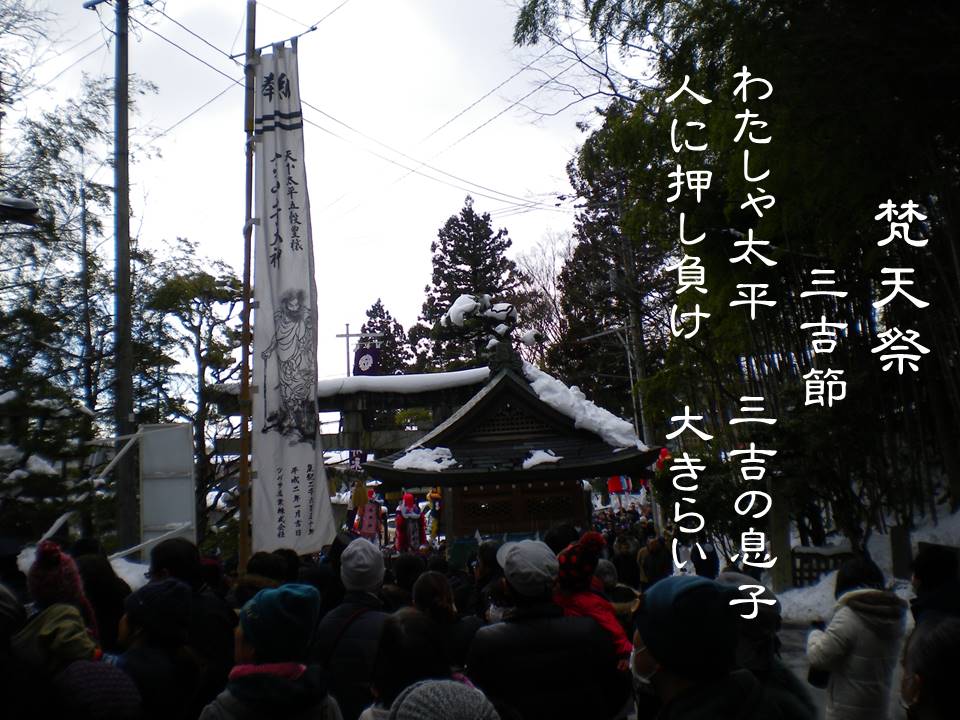
I am a son of Miyoshi
in Mount Taihei
I dislike
being defeated
Bonden festival song (Translated by Hidenori)
The festival song is sung in dedicating Bonden「梵天, a sacred object」to the shrine, where En no Ozunu, or Miyoshi is deified as one of the enshrined deities of the shrine. The image of Miyoshino-ō-kami「三吉霊神」in the Bonden flag is almost the same as En no Ozunu’s image in a piece of the sketches in The Hokusai Manga .
Note: Bonden as Shinto Ritual Objects
According to historical documents found in Yokote City, bonden originated as religious objects called heisoku, wooden wands that are used in Shinto rituals. Heisoku were also referred to as bode, and practitioners of Shugendō, a form of mountain asceticism that is rooted in Shinto, combined the term bode with the name of their guardian deity Daibontenō to create the word bonden.
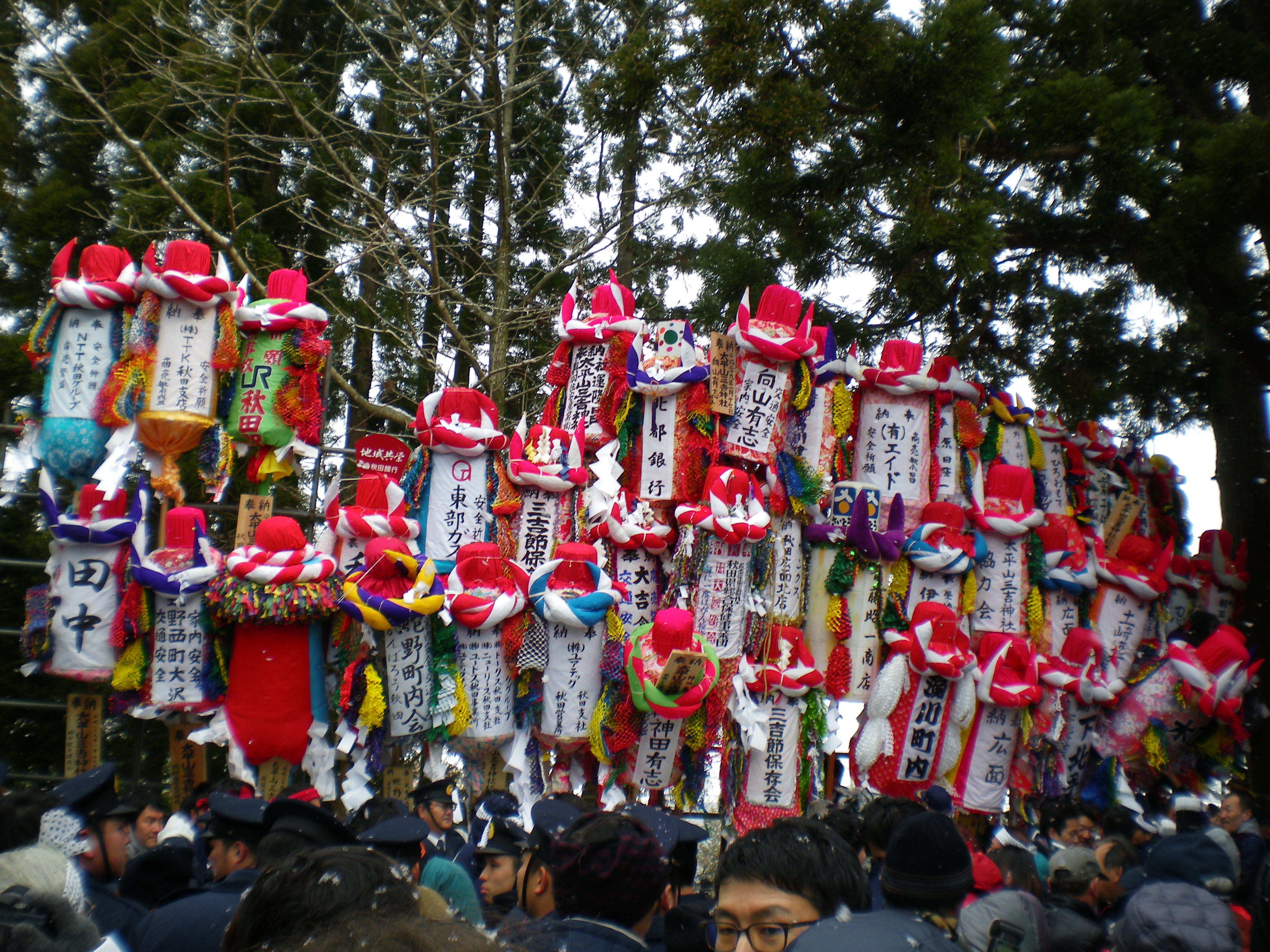
The bonden displayed during the Winter Festival competition come in a variety of designs, each of which is created by the individual neighborhood or company it represents. Some groups follow traditional designs, with elements such as pagodas, altars, or the zodiac animal of the year, while other groups incorporate modern design motifs such as sports mascots. Regardless of the motif, participants seeking to have their bonden displayed must follow strict specifications regarding its shape, dimensions, and composition.
First, the bonden’s pole must be a total of 4 meters long. On top of the pole, there is a bamboo basket 90 centimeters across, from which hang 270-centimeter strips of cloth called sagari. Next are the shide, paper streamers used on the heisoku wands, and the hachimaki (literally, “headband”) that wraps around the basket. The elaborate decorations added to the top of the bonden, known as the atamakazari, must have a base of 120 centimeters or smaller, and its height should not exceed 150 centimeters.
At the turn of the nineteenth century, most decorations were made of bamboo, wire, and cloth, but modern decorations can include lightweight materials like Styrofoam, which has led to even more elaborate designs.
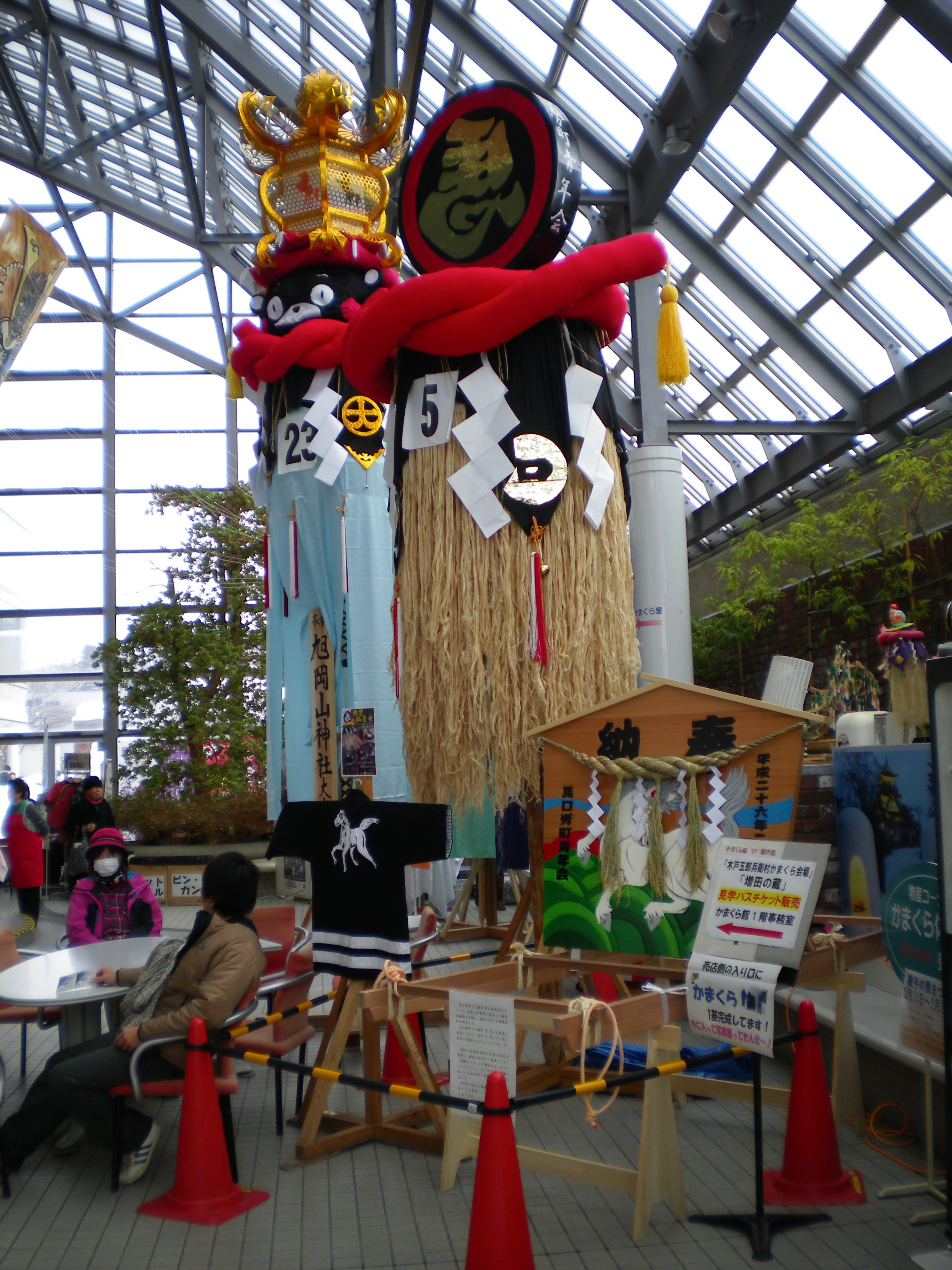
Note: The Bonden Festival (Bonden-matsuri) 梵天祭(ぼんでんまつり)
The Bonden Festival is held on January 17 at the Taiheizan Miyoshi Shrine in Akita City. Bonden consists of a pole on top of which is a figure of the animal of the year. From the pole hang long streamers of paper or cloth and a strip of white paper used in a Shinto ritual.
Teams of young men carrying the bonden do their best to be the first to reach the shrine and place the bonden inside. Afterwards they make an offering of the bonden to the god to pray for a bountiful harvest, prosperous business and the safety of their families during the year.
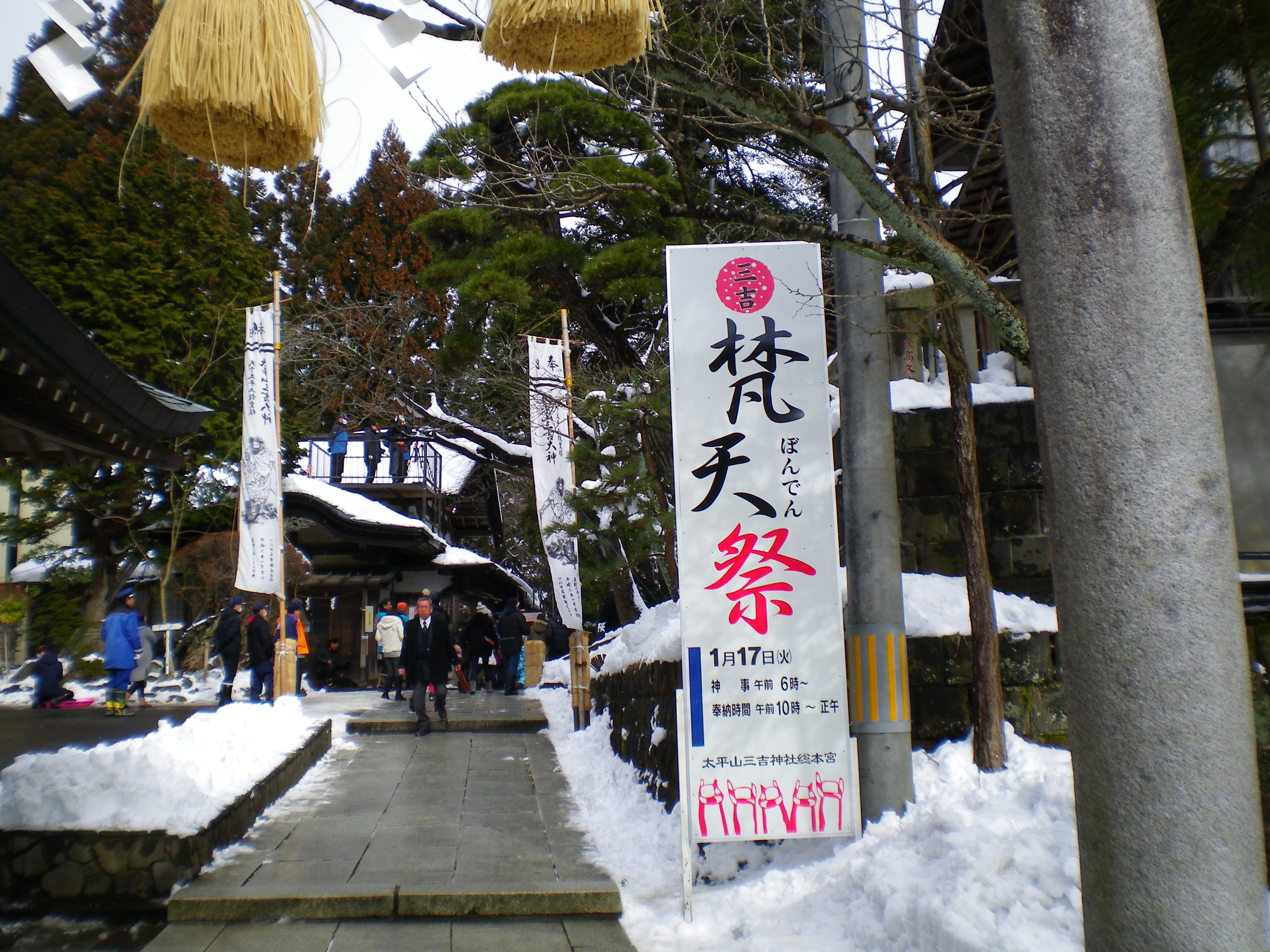
Hidenori Hiruta
Akita International Haiku Network

 Akita International Haiku Network
Fascinating and appreciate you sharing the tradition here.